-
Consumers could be misled as to the reality of the farmed salmon they are purchasing, finds new report by WildFish.
- The report comes as new footage emerges from farms run by companies supplying the Royal Household, Michelin-starred chefs and UK supermarkets, following a UK Government decision to allow Scottish farmed salmon to be marketed as simply ‘Scottish salmon’.
- More than 350 chefs, restaurants, charities and community groups join call for farmed salmon to be taken Off the table.
SCOTTISH farmed salmon is being marketed in such a way that consumers could be misled as to the origin, welfare and environmental performance of their purchases, claims a new report by the independent charity WildFish.
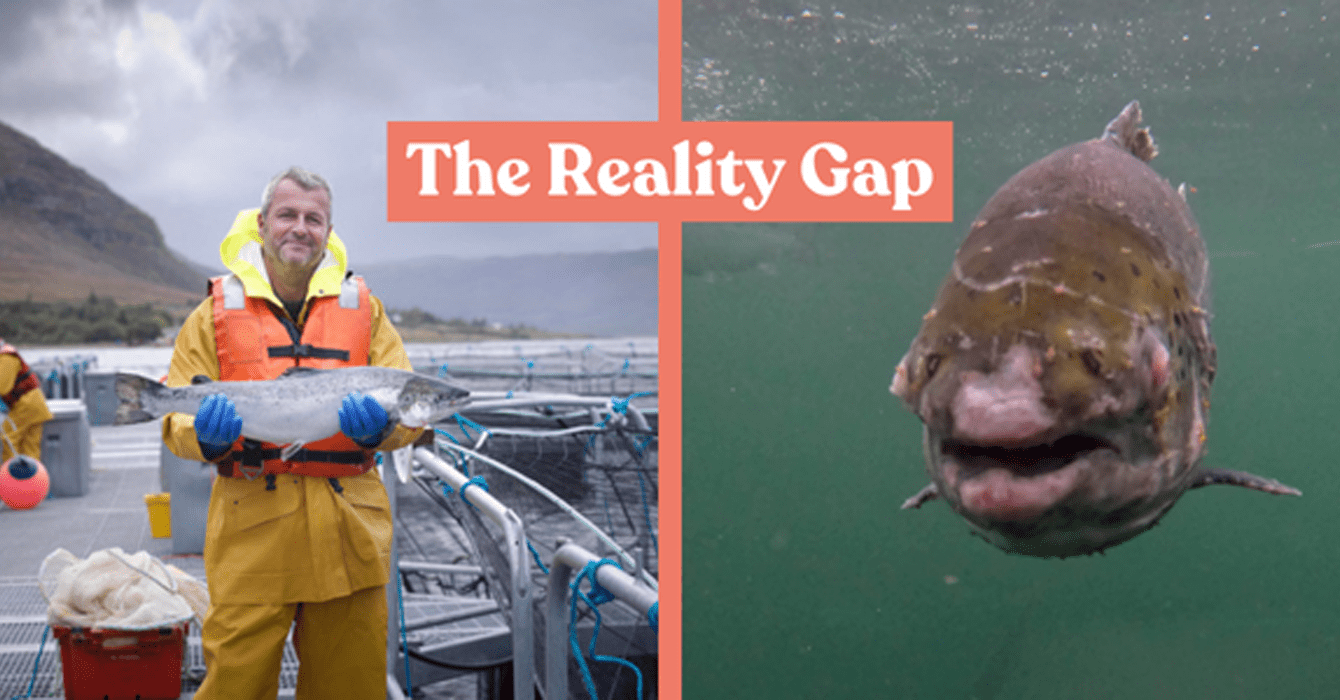
The report, The Reality Gap: An examination of Scottish farmed salmon, analyses marketing tools used by the Scottish salmon farming industry and compares these with mortality rates, sea lice levels and chemical usage on farms run by Scotland’s seven salmon farming companies.
It finds that Scottish farmed salmon is being positioned as a premium, high welfare and (in some cases) sustainable fish product, when in reality none of the companies are currently operating in a way which adequately protects both fish welfare and the environment.
These companies supply farmed salmon to major UK retailers including Tesco, Sainsbury’s and Waitrose; food outlets such as Leon; and high-end restaurants. They are also in many cases being endorsed by celebrity chefs.
Lex Rigby, farmed salmon campaign manager at WildFish, said: “Consumers of farmed salmon are being sold a mistruth – one that perpetuates the idea that fish raised in an intensive and destructive production system, where 25% of the fish die prematurely, are ‘responsibly produced’ and environmentally sustainable.
“Clever marketing tactics have consumers believing the Scottish salmon industry is picture perfect, but in reality none of the salmon farming companies are currently operating in a way that protects both wild fish and farmed fish welfare, nor the wider environment.”
On the marketing side, the report details the various tools used by the industry to distance its fish from the heavily industrialised way in which it is produced. These tools include certification schemes such as RSPCA Assured and Soil Association ‘organic’; the use of an updated Protected Geographical Indication (PGI) (2); and own-brand labels, smokehouses and third-party suppliers.
Using data published by the Scottish Government and disclosed by the seven salmon farming companies themselves, the report also analyses the mortality rates, sea lice levels and chemical usage on Scotland’s salmon farms.
Key findings include:
- Mowi, the world’s largest salmon farming company and supplier to Tesco, Asda, Sainsbury’s and the Royal Household, reported almost 5 million farmed salmon deaths on its farms in 2023. It also used 1.3 million litres of hydrogen peroxide across that period. Between 2013 and 2023, the company has doubled its use of the organophosphate pesticide Azamethiphos.
- Wester Ross, which supplies the chain restaurant Leon and has a large US export market, continues to market its fish as being ‘hand reared’ through third-party supplier sites, despite moving towards automation since it was purchased by Mowi in 2022. The company used more than 6,000 litres of hydrogen peroxide in 2023. It claims that it does not use any medicines on its farms.
- Loch Duart, marketed as higher welfare premium salmon and served at the Downing Street Coronation lunch in 2023, breached Code of Good Practice (CoGP) sea lice levels on more than one third of its farms in 2022. They also reported using over 41,000 litres of hydrogen peroxide in 2023.
- The marketing for Bakkafrost’s Native Hebridean Salmon brand, endorsed by Jack Stein and Gary Maclean, could arguably lead to confusion for consumers as to whether the salmon is wild or farmed. Bakkafrost has suffered some of the highest mortality rates on its farms in recent years, with two sites reporting more than 80% mortality in 2022 and 2023.
Farmed salmon is one of the most popular fish in the UK, constituting one of the so-called ‘Big Five’ – cod, tuna, prawns, salmon and haddock. Together these represent 62-80% of the UK’s total fish consumption.
However, concerns have long been raised around the detrimental impacts of the salmon farming industry on Scotland’s lochs and coastal waters, wild Atlantic salmon populations and farmed fish welfare, as well as the wider marine environment and food justice.
On account of this, there is a growing call across the UK and internationally for the hospitality and retail sector to move away from open-net farmed salmon. More than 350 chefs, restaurants, community groups, charities and NGOs are supporting WildFish’s Off the table campaign, which asks chefs and restaurants to take farmed salmon off their menus.
Ms Rigby continued: “The sheer number of chefs and restaurants joining Off the table clearly shows what a keen appetite there is for sustainability within our hospitality sector in the UK – and further afield. In turn, consumers are becoming increasingly aware of the high environmental cost and poor welfare standards of farmed salmon – regardless of industry marketing strategies implying otherwise.”