
Most conversations about the future of drinks production are conducted at the level of strategy, which is a pity, because efficiency is rarely won there. It is won by finding small losses, measuring them properly and fixing them consistently, several levels below where the strategy is written.
Consider a conductivity meter on a CIP line with faulty cable routing. An unreliable electrical signal can result in cleaning agent being over- or under-dosed, while something as simple as a worn seal on an electromagnetic flow meter can allow liquid ingress over time and eventually lead to incorrect measurements, insufficient cleaning and, in the worst case, product recalls. Writing for BrauBeviale's Industry Insights, food technologist Thomas Birus notes that the cost of an unplanned production stoppage can run into tens of thousands of euros within hours once staff time and product losses are taken into account, before potential penalties for non-delivery.
Finding those losses starts with measuring what is actually being consumed. Litres of water per litre of beverage, kilowatt-hours per cubic metre, detergent consumption, packaging units per thousand litres and product loss rates all provide meaningful benchmarks when tracked consistently. Water and wastewater can produce measurable results particularly quickly, while improvements in resource efficiency can reduce operating and disposal costs alongside environmental impact.
The same principle applies further down the line, where apparently minor variables can have an outsized effect on reliability. In robotic packaging applications, repeatability can be more important than absolute accuracy, while even subtle changes to a cardboard surface or printing ink can affect the way a gripper handles a product and increase error rates. These are precisely the kinds of details worth discussing directly with equipment and automation suppliers.
Artificial intelligence is also changing how quickly such issues can surface. Machine learning can identify known faults such as poorly applied labels or illegible best-before dates, while unsupervised systems can flag hidden anomalies in process data. Predictive maintenance and real-time analysis offer further opportunities to reduce downtime and wastage. Whether that delivers value, however, depends on using AI where the benefit is clear and, as Barbara Engels of the German Economic Institute argues, considering implementation and cybersecurity together from the outset.
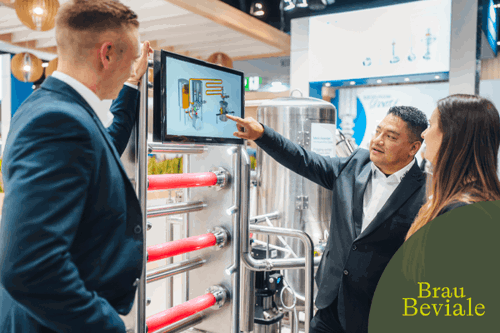
These are questions that can be easier to explore face to face than through a specification sheet. From 10 to 12 November, BrauBeviale 2026 will bring together suppliers across process technology, automation, energy, packaging, analytics and the wider beverage-production chain, giving producers the opportunity to examine what these incremental gains could mean for their own operations.